Sunscreen 101
The Importance of SPF
SPF, which stands for Sun Protection Factor, measures how well a sunscreen can protect your skin from harmful UVB rays. UVB rays are the ones that cause sunburn and contribute to skin cancer. The SPF number indicates how much longer it takes for the sun’s rays to redden your skin in comparison to if you weren’t wearing any sunscreen.
SPF 15
Blocks 93% of UVB rays
SPF 30
Blocks 97% of UVB rays
SPF 50
Blocks 98% of UVB rays
SPF 90
Blocks 98.5% of UVB rays

Protection Levels
Higher SPF numbers offer greater protection, but after SPF 30 it doesn’t add much more protection so we recommend SPF 30 which blocks up to 97% of UVB rays. When comparing SPF levels, SPF 15 blocks about 93% of UVB rays, SPF 30 blocks 97%, and SPF 50 blocks approximately 98%.
Reapplication
Sunscreen should be reapplied every two hours, or more frequently if swimming, sweating, or towel drying regardless of the SPF level.
Broad Spectrum
A broad spectrum SPF protects you from both UVA and UVB rays. UVA rays penetrate deeper into the skin causing tans, skin aging, dark spots, wrinkles (damages collagen and elastin in the skin), and can lead to skin cancer. UVB rays don’t penetrate as deep into skin layers, but they cause burns. In conjunction with UVA rays, both types of UV rays can work to alter skin cells leading to melanoma and skin cancer.
Understanding Melanin
Melanin is a natural pigment found in the skin, hair, and eyes, produced by cells called melanocytes. These cells determine the range of skin tones observed in humans and provide some protection against UV radiation by absorbing and dissipating sunlight. However, melanin is not a substitute for sunscreen. Melanin provides a level of UV protection equivalent to about SPF 13 for deep skin tones. This is insufficient to prevent all forms of sun damage, including sunburns and DNA damage that can lead to skin cancer. Despite higher melanin levels, individuals with deep skin tones are still vulnerable to sun damage. This can result in sunburn, hyperpigmentation, premature aging, and an increased risk of skin cancer.
Understanding Sunscreen For All
Skin Is Skin:
Regardless of your skin color, sunscreen is a crucial part of your skincare routine. A common misconception is that individuals with deeper skin tones do not need sunscreen. This belief can lead to significant consequences, as melanin, the pigment that gives skin its color, offers only limited protection against the sun’s harmful ultraviolet (UV) rays. Understanding the role of melanin and the importance of sunscreen for all skin tones is essential for maintaining healthy skin.
Why Black People Need Sunscreen
Preventing Hyperpigmentation
Hyperpigmentation, a common concern for those with darker skin tones, can be worsened by sun exposure. Sunscreen helps prevent further darkening of dark spots and promotes a more even complexion.
Combating
Premature Aging
UV exposure accelerates the aging process, leading to fine lines, wrinkles, and loss of skin elasticity. Sunscreen helps slow down this process by protecting the skin from the sun's damaging rays.
Reducing Skin
Cancer Risk
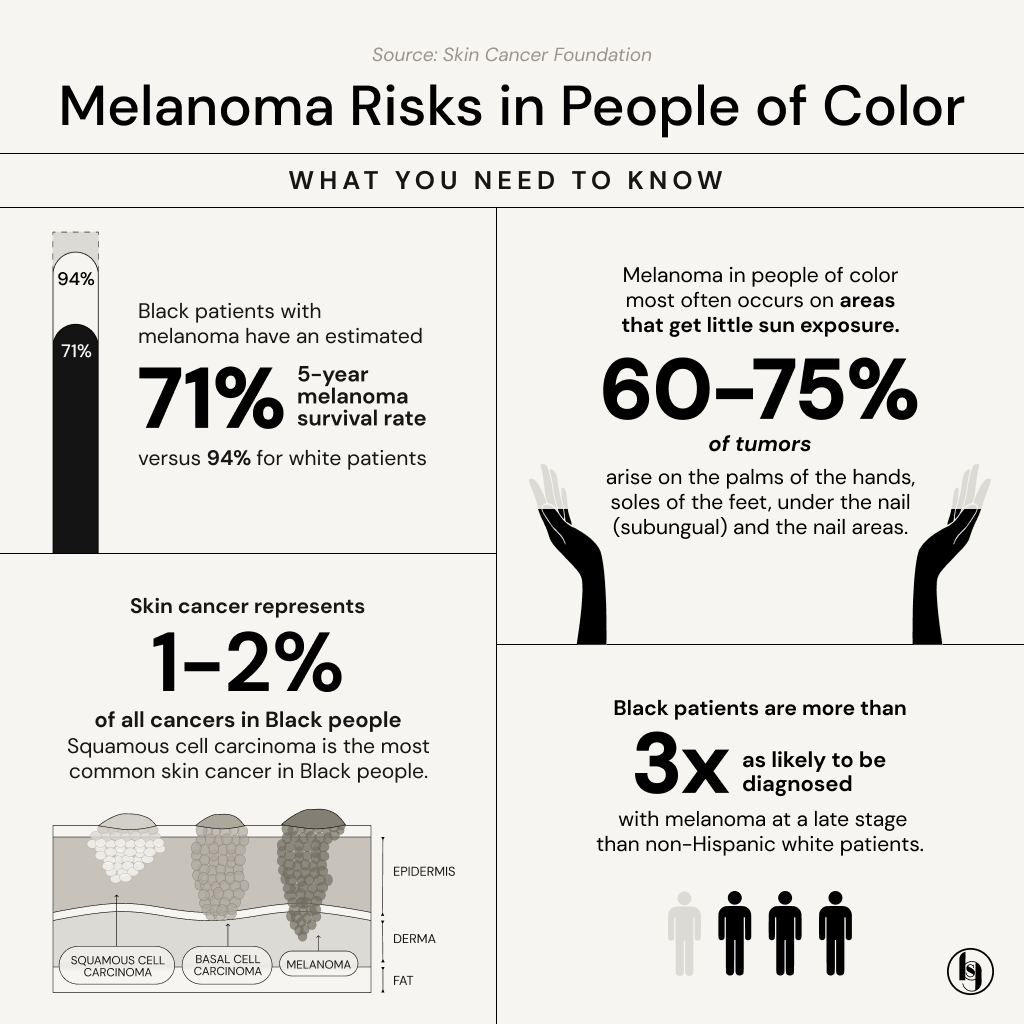
Although skin cancer is less common in individuals with darker skin, it is often diagnosed at a more advanced stage, making it more difficult to treat. Regular use of sunscreen reduces the risk of skin cancer by providing a protective barrier against harmful UV rays.
Protecting
Against Sunburn
Hyperpigmentation, a common concern for those with darker skin tones, can be worsened by sun exposure. Sunscreen helps prevent further darkening of dark spots and promotes a more even complexion.
BGS Product Standards
All BGS Products Are
Vegan
Black Owned
Have a Robust Restriction list
Paraben Free
Formulated without Octinoxate & Oxybenzone
HAVE A QUESTION?
No problem! We’re always here to help. Just click below for assistance.